Salzburg in 2 days: a focused weekend itinerary
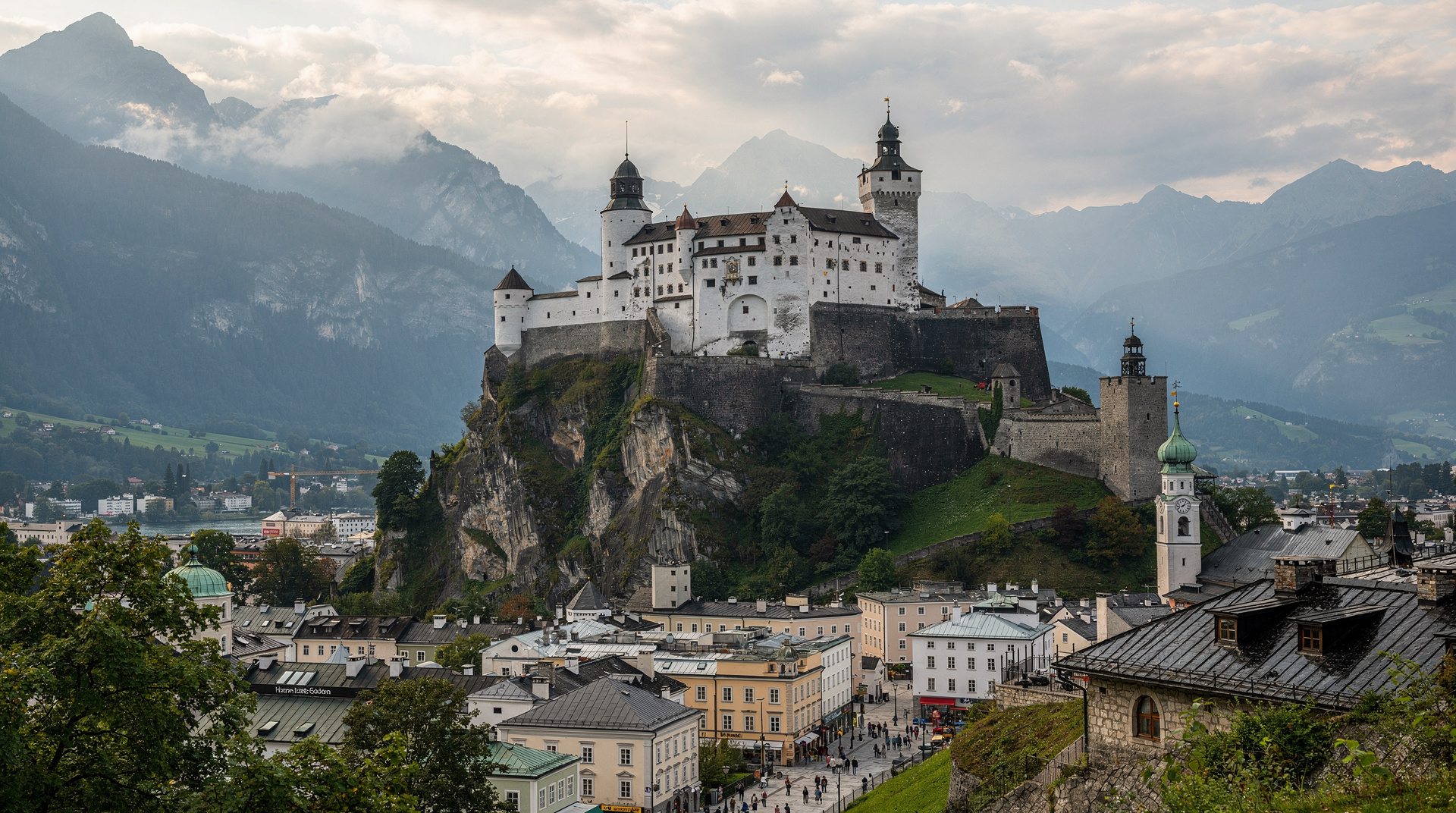
Salzburg: Hohensalzburg Fortress Admission Ticket
Two days is the sweet spot for first-time visitors. It gives you a full city day without rushing — fortress, Altstadt, Mozart, an evening concert — and a second day for the region’s single most compelling destination, whether that is Hallstatt, Eagle’s Nest, or Berchtesgaden. You will leave having understood what Salzburg is: a compact, architecturally dense baroque city that also happens to sit at the gateway to one of Europe’s great lake and mountain regions.
If you are considering whether two days is enough, the honest answer is yes for the highlights, but three days is noticeably more relaxed. See our detailed breakdown in the how many days in Salzburg guide. For more depth, our 3-day Salzburg itinerary is the recommended upgrade.
At a glance
| Structure | Day 1: full city. Day 2: one excursion (Hallstatt or Eagle’s Nest) |
| Cost per person | approx. 130–225 € for both days (excl. accommodation) |
| Car needed | No — tours or train/ferry cover the excursion day |
| Best months | May, June, September, October |
| Book ahead | Fortress ticket + day-2 tour/bus, especially July–August |
Why the two-day structure works
Day one is entirely within the city: Mirabell, Altstadt, Mozart, the fortress, an evening in a beer garden or concert hall. Day two is a single focused excursion — one destination done properly rather than two done badly. This structure avoids the common mistake of trying to fit Hallstatt, Eagle’s Nest, and the city into 48 hours simultaneously, which results in nothing being done justice.
Day 1: The city in full — Altstadt, fortress, Mozart, Mirabell
Morning (08:30–12:30)
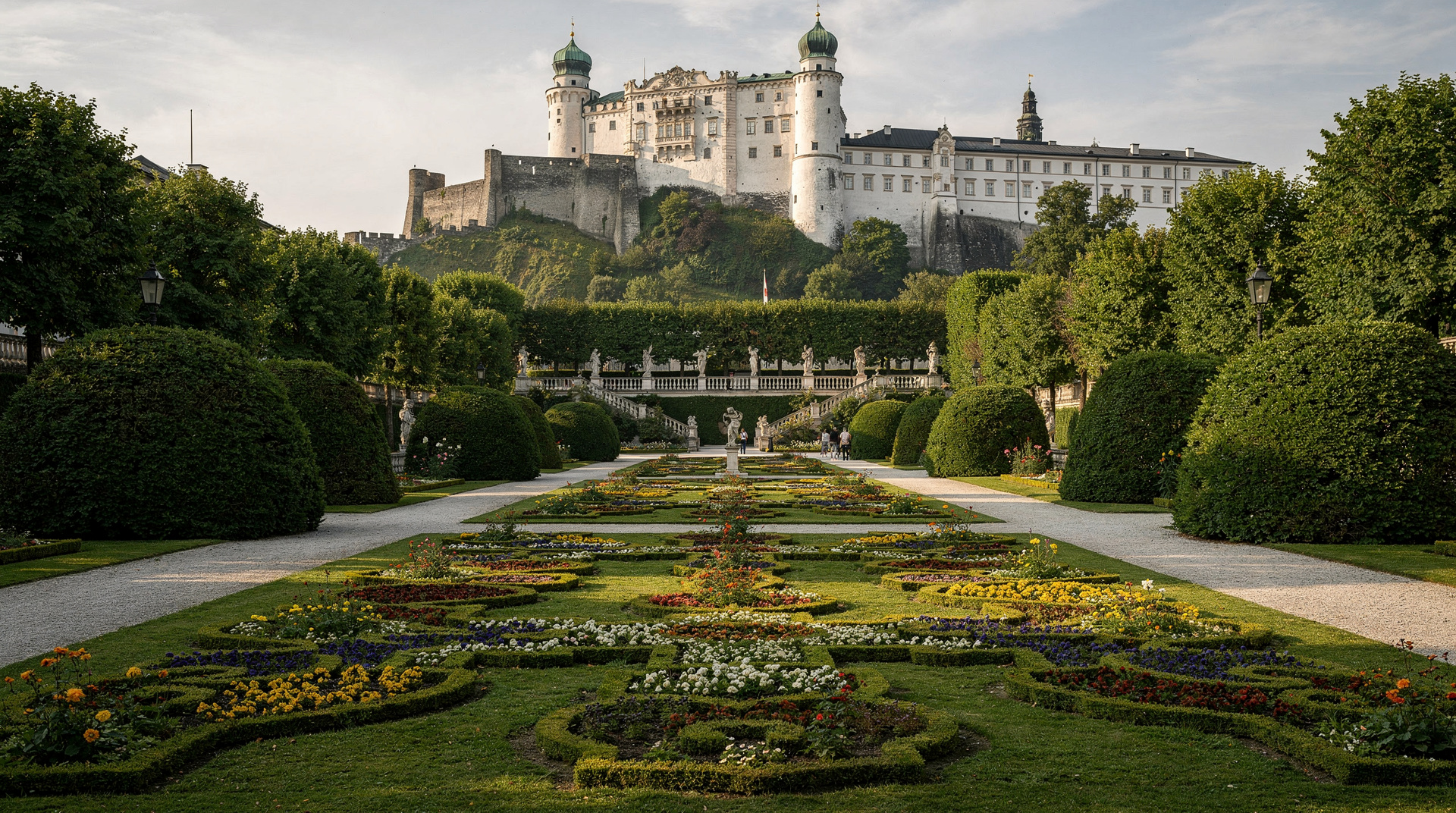
Start early at Mirabell Palace and Gardens. The gardens open around the clock and are free; the Pegasus fountain and the Sound of Music staircase look best before 09:30 when the tour groups arrive. Spend 30–40 minutes here then walk south across the Salzach toward the old town.
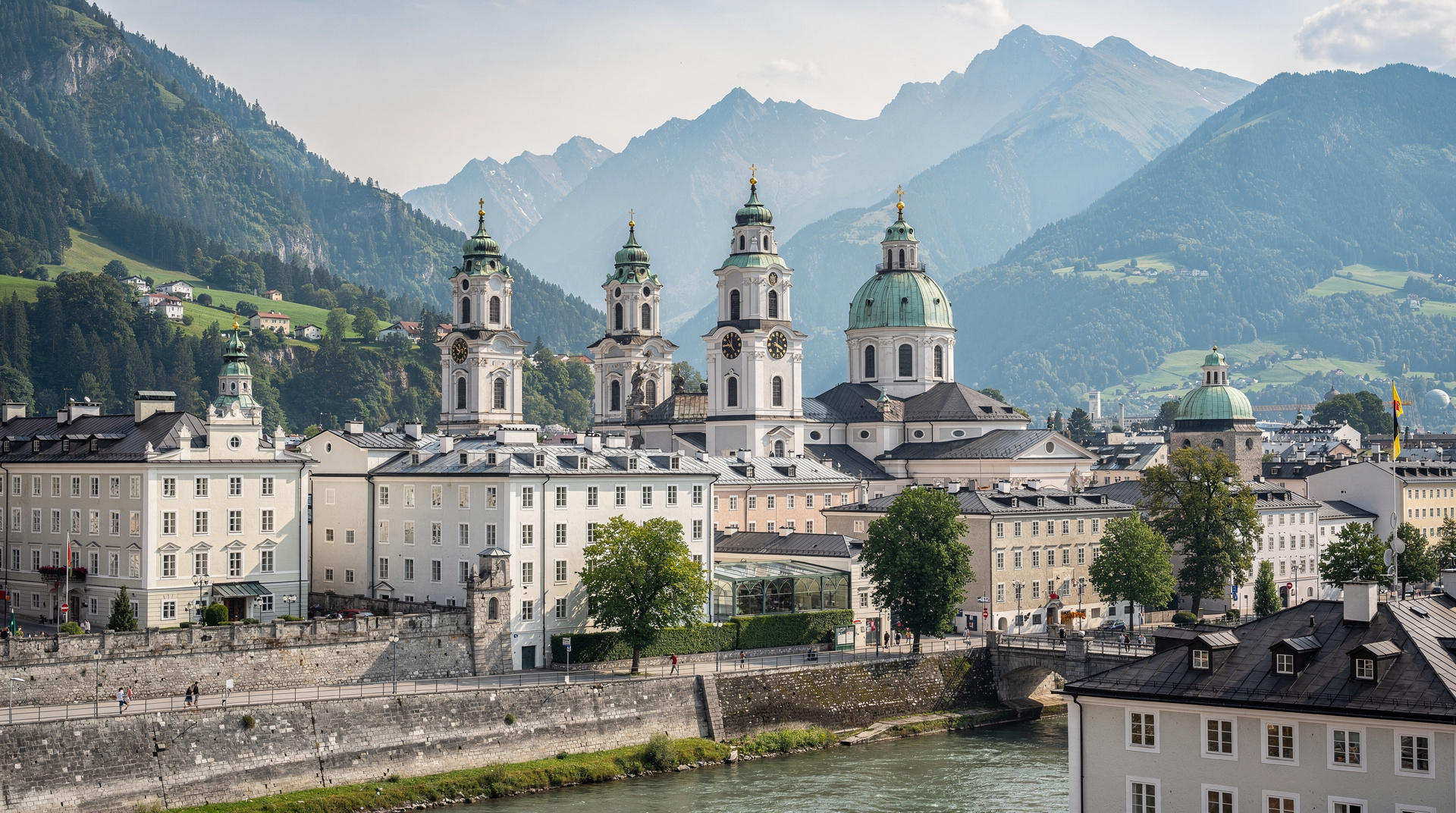
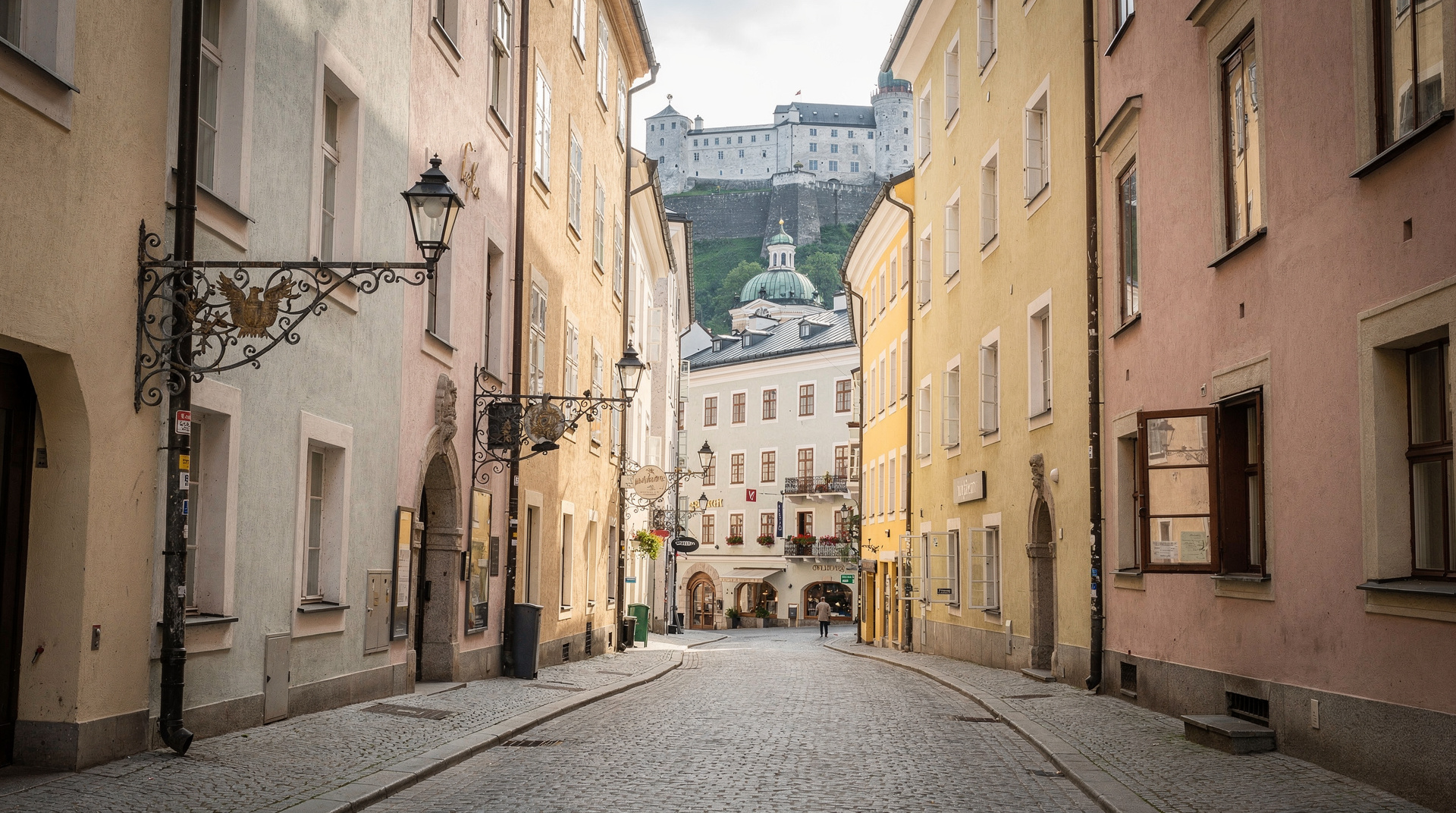
Cross Staatsbrücke and enter Salzburg Altstadt, UNESCO-listed and justifiably so: the density of baroque churches, palaces, and merchants’ houses in this small area is extraordinary. Head directly to Getreidegasse — the famous narrow street with its wrought-iron guild signs — and stop at number 9 for Mozart’s birthplace.
Mozart Geburtshaus (approx. 12 €) occupies the upper floors of the building where Mozart was born in 1756. The apartment and its exhibit of early compositions, instruments, and family portraits takes about 45 minutes. It is worth doing for most visitors; the deeper Mozart experience (Wohnhaus, concerts) can wait for day two or a longer trip. See our honest Mozart birthplace vs. residence comparison if you want to weigh both museums.
By 10:30, walk south through Kapitelplatz to the base of the fortress hill. Take the funicular up to Hohensalzburg Fortress — the funicular is included in the standard fortress ticket. The Hohensalzburg Fortress admission ticket covers the funicular, the Princes’ Chambers, the Audio Guide, and the marionette museum. Allow 90 minutes to see it properly.
Tip on the funicular vs. walking: The walk up Festungsgasse takes 15–20 minutes and saves the supplement, but the fortress view from the funicular cabin is actually a highlight in itself. Walk up if the queue is very long; take the funicular otherwise. Our fortress funicular vs. walk guide has the full breakdown.
Afternoon (12:30–17:30)
Descend from the fortress by 12:30 and eat. Triangel on Wiener-Philharmoniker-Gasse is a reliable honest-value Austrian restaurant five minutes from the cathedral. Café Tomaselli on Alter Markt is the city’s oldest café and worth a long coffee with Strudel, even if it is tourist-frequented: the setting is genuine, the coffee is good, and the service is professional.
Spend the afternoon in the Residenz quarter. The DomQuartier ticket (approx. 16 €) covers the Residenz palace state rooms, the Cathedral Museums above the Salzburg Cathedral, and the walkway connecting them — about 2 hours of unhurried exploring. The DomQuartier walking tour adds a guided context that significantly improves the visit.
Salzburg Cathedral (free entry) is directly adjacent and should not be missed: the baroque interior — white marble, gilt stucco, frescoed vault — is among the finest anywhere. Mozart was baptised here; the font is in the north transept and is still used.
End the afternoon with a slow walk along the Salzach riverfront on the left bank: Imbergstiege staircase, Nonntaler Hauptstrasse toward Nonnberg Abbey (the Sound of Music convent, exterior visible for free).
Evening (18:00–21:00)
Two good options depending on your budget and preference:
Augustiner Bräustübl (north of the city, 15-minute walk from Altstadt) is a vast monastery beer garden serving Augustiner draught beer from stone jugs at wooden tables under chestnut trees. Cold food only — pick up sausages, pretzels, and cheese from the vendors inside. It is entirely local in character. Expect to spend 15–25 € per person on beer and food.
Classical concert: If you pre-booked, tonight is ideal for a fortress concert or a Mirabell Palace recital. See our best Mozart concerts in Salzburg guide for a frank assessment of what each concert option actually delivers.
Day 2: Hallstatt (recommended) or Eagle’s Nest
The single biggest decision of a 2-day Salzburg visit is how to spend the second day. Below are the two best options. Both require leaving the hotel by 08:00–09:00.
Option A: Hallstatt (recommended for most visitors)
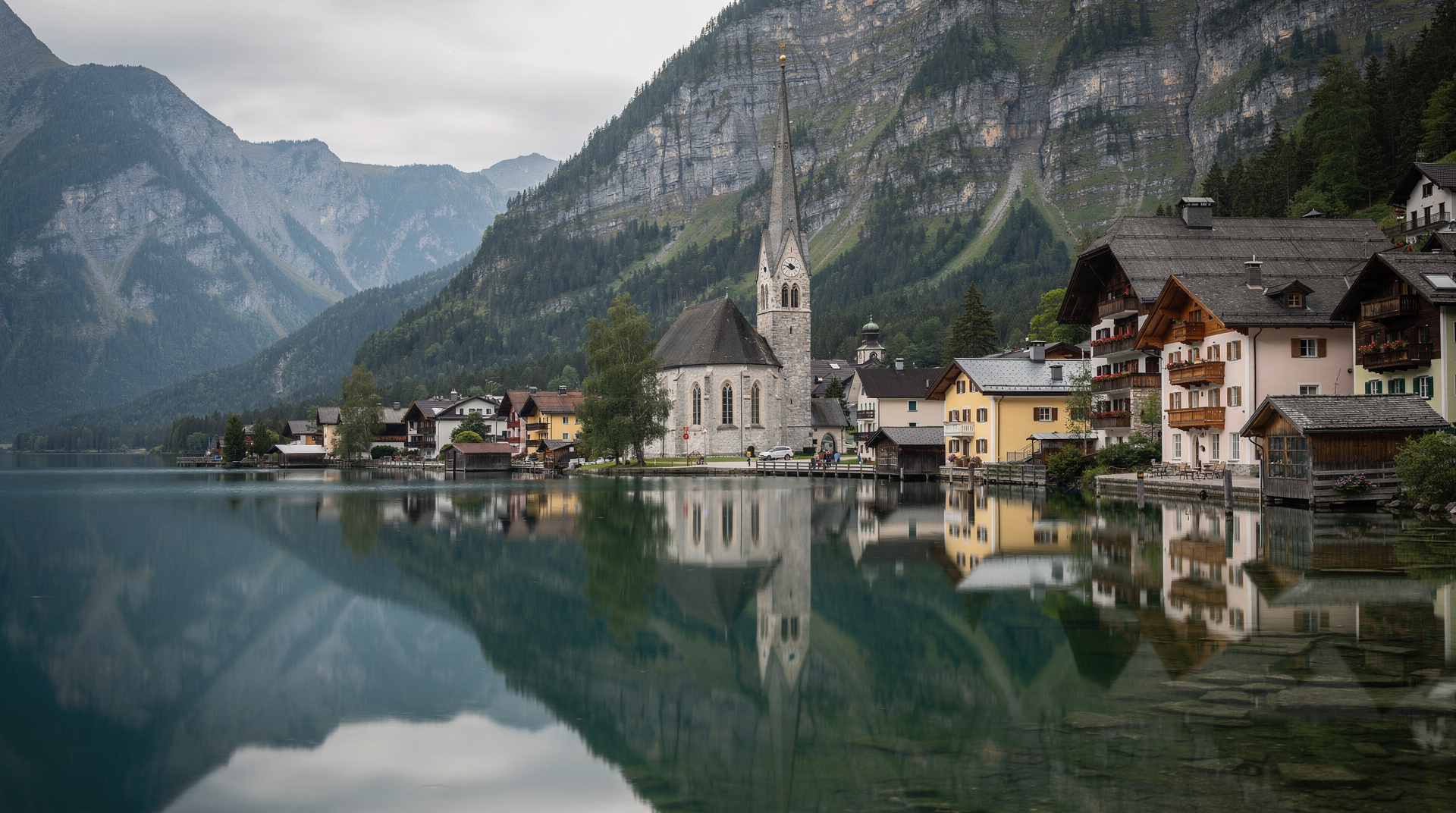
Hallstatt is the most photographed village in Austria and the one most visitors regret not seeing. It sits on a narrow ledge between a steep mountain and the dark Hallstätter See, about 1 hour by car or 2h15 by public transport from Salzburg.
Getting there without a car: The most practical no-car option is a guided bus tour. The half-day Hallstatt tour from Salzburg departs early, handles all logistics, and gives you 3–4 hours in the village. For more time and flexibility, the private tour versions add a full day including St. Gilgen. See our detailed Hallstatt day trip guide for all transport options.
By public transport (train + ferry): Take the ÖBB train from Salzburg Hauptbahnhof to Attnang-Puchheim (40 minutes), change for Hallstatt station (another 60 minutes), then take the ferry across the lake to the village (10 minutes). Total journey: about 2h15 each way. The ferry runs every 20–30 minutes when trains arrive. Cheaper than a tour (approx. 25–30 € return) but you have less time in the village.
What to see in Hallstatt:
- The village square (free) and boat landing — allow 30 minutes to walk the main street
- The Bone Chapel at the Catholic church (3 €) — small but genuinely striking
- The Hallstatt Skywalk viewpoint via funicular (16 €) — views over the lake and village; worth doing if the sky is clear
- Salt mine tour (salt mine + funicular combo approx. 38 €) — the mine is genuinely interesting; the slides and underground lake are family-friendly, but it adds 2 hours. Read our Hallstatt salt mine and skywalk guide before deciding.
Critical timing: Hallstatt is heavily overcrowded between 11:00 and 16:00 in summer (June–August). Arriving by 09:00–09:30 (especially by car) means you see the village in peace. By midday it is unpleasant. Read our Hallstatt overcrowding guide for full detail on when to go and when to leave.
Return to Salzburg by 17:00–18:00 for dinner.
Option B: Eagle’s Nest and Berchtesgaden
Eagle’s Nest (Kehlsteinhaus) is an extraordinary piece of Nazi-era history perched at 1834 m above Berchtesgaden — Hitler’s 50th birthday gift, accessible by a single tunnel-and-elevator system built directly into the mountain. The historical complexity and the views make it one of the most unusual sites in the Alpine region.
Getting there: Berchtesgaden is 45 minutes from Salzburg by car. The Eagle’s Nest is accessible only by the dedicated Kehlstein bus from Berchtesgaden bus station (May to October only — it is closed in winter). The Eagle’s Nest and Berchtesgaden tour from Salzburg handles all transport and includes a guide for the historical context, which genuinely matters here.
Königssee addition: If you arrive in Berchtesgaden by 09:00, combine the morning with a Königssee boat trip — the electric boat glides silently along a fjord-like lake to St. Bartholomew church, with the captain performing a trumpet echo off the cliff walls. Allow 1.5–2 hours for a return boat trip. See our Königssee boat guide.
Important: Eagle’s Nest requires booking the Kehlstein bus in advance in peak season, and the bus only runs May to October. Plan accordingly. Our Eagle’s Nest visit guide covers everything.
Adapting for a car vs. no car
With a car: Both Hallstatt and Eagle’s Nest are significantly easier. Drive to Hallstatt in 1 hour, park at one of the satellite car parks (arrive by 08:30 to get a space), walk into the village. Eagle’s Nest requires a car to reach Berchtesgaden; from there, the Kehlstein bus is mandatory regardless.
Without a car: Use guided tours for both options — they handle bus logistics that would otherwise require multiple train changes. For Hallstatt specifically, the train+ferry route works well but costs 2h15 each way. For Eagle’s Nest, the tour is genuinely the better option; the bus connections from Salzburg to Berchtesgaden require a change in Bad Reichenhall or Freilassing.
Which is easier without a car: Hallstatt (the tour infrastructure is mature and frequent). Eagle’s Nest is manageable but requires more coordination.
Costs and logistics
Day 1 per person:
- Fortress ticket: 16 €
- Mozart Geburtshaus: 12 €
- DomQuartier: 16 €
- Lunch: 18–25 €
- Beer garden evening: 15–25 €
- Total: 77–94 €
Day 2 per person (Hallstatt):
- Bus tour: approx. 35–65 € depending on option
- OR train + ferry: approx. 30 €
- Hallstatt village entry: free
- Bone chapel: 3 €
- Salt mine + funicular: 38 € (optional)
- Lunch in Hallstatt: 18–25 €
- Total: 50–130 € depending on options chosen
Accommodation: Salzburg city centre hotels in the Altstadt run 80–200 € per night for mid-range options. Booking 2–3 weeks ahead in summer saves considerably. See our where to stay in Salzburg guide for neighborhood-by-neighborhood analysis.
If you can only pick one: Hallstatt or Eagle’s Nest, compared
Both are strong day-2 options and this itinerary defaults to Hallstatt, but the honest comparison matters if you’re undecided:
| Hallstatt | Eagle’s Nest | |
|---|---|---|
| Distance | 1h (car) / 2h15 (train+ferry) | 45 min to Berchtesgaden + Kehlstein bus |
| Season | Year-round | Mid-May to October only |
| Best for | Photography, lake villages | WWII history, alpine views |
| Crowd risk | Severe, 11:00–16:00 in summer | Moderate — bus capacity limits numbers |
| Cost per person | 50–130 € depending on options | 65–105 € incl. Königssee |
| Regret factor if skipped | High — most first-timers wish they’d gone | Lower unless WWII history interests you |
Most first-time visitors choose Hallstatt and are right to; it is the more universally photogenic and requires less context to appreciate. Eagle’s Nest rewards visitors with a specific interest in the history, and the guided commentary (rather than the view alone) is what makes the money worth spending.
A third option worth considering if neither quite fits: Werfen’s Eisriesenwelt ice cave and Hohenwerfen Castle, 45 minutes south, work as a lower-crowd alternative that runs May–October and suits visitors who find both Hallstatt’s crowds and Eagle’s Nest’s history less appealing than a genuinely dramatic natural site. It requires booking ahead in peak season for cave slots, and it is a longer, more physical day than either of the two main options — allow the full day and expect a 45-minute uphill approach walk before the guided cave tour itself.
Extending to a third day if you have it
If your schedule has any flexibility, adding a third day is the single highest-value change you can make to this itinerary — not because two days is insufficient, but because it removes the current itinerary’s only real compromise: choosing between Hallstatt and Eagle’s Nest instead of doing both. Our 3-day Salzburg itinerary simply adds the second excursion as its own day, with no other changes to the structure above. If a third day isn’t possible, the choice above is genuinely fine — most visitors report no regret either way, provided the day-2 excursion they picked matched their actual interests.
Frequently asked questions about two days in Salzburg
Is 2 days enough for Salzburg?
For a first visit covering the city’s main sights plus one significant day trip, yes. You will leave having seen the fortress, Altstadt, Mozart, and either Hallstatt or Eagle’s Nest, and having had at least one good evening. What you will miss is a deeper look at the Salzkammergut lakes region or the Alpine road trips. Two days is satisfying; three days is genuinely relaxed.
Should I go to Hallstatt or Eagle’s Nest?
Hallstatt if you prefer landscapes and photography: the village on the lake is one of Austria’s most iconic images. Eagle’s Nest if you are interested in World War II history and don’t mind altitude (and that the site is only open May to October). Most first-timers choose Hallstatt; return visitors often prefer Eagle’s Nest for the historical depth.
What time should I leave for Hallstatt?
Leave Salzburg by 08:00 at the latest to arrive in Hallstatt by 09:00–09:15. This is non-negotiable in summer (June–August) if you want to see the village before it is packed. Arriving at 10:30 in peak season means navigating crowds. Our Hallstatt overcrowding guide has season-by-season timing advice.
Can I book everything on the day of arrival?
For the city itself (fortress, Mozart, DomQuartier) you can usually book on the day in shoulder season (April–May, September–October). In July and August, book fortress tickets ahead. For Hallstatt tours, book 24–48 hours ahead in summer. For Eagle’s Nest, book the bus and any guided tour at least a week ahead in July–August.
What is the best evening activity in Salzburg?
Depends on your interests. For atmosphere and authenticity: Augustiner Bräustübl beer garden (no booking needed, no tourist trap, genuinely wonderful on a warm evening). For culture: the Mirabell Palace concert or the Hohensalzburg Fortress dinner concert. For something in between: a Salzach riverside dinner at a restaurant like Bärenwirt on the right bank.
Do I need a car for a 2-day visit?
No. The city itself is entirely walkable, and both day-2 excursions (Hallstatt, Eagle’s Nest) run as guided tours with pickup in the city centre, or via train/ferry for Hallstatt. A car only helps if you also want the flexibility to stop at extra spots like Gosausee en route — genuinely nice, but not necessary for a first 2-day visit.
What if I only have one night, not two full days?
If you’re arriving late on day 1, compress Day 1 of this itinerary into an afternoon-and-evening arrival (fortress and Mirabell only, skip the DomQuartier), then run Day 2 as written. Our 1-day itinerary has the priority order if you need to cut further.
Practical information for a 2-day visit
Getting around the city
Salzburg’s Altstadt is entirely walkable — the distance from Mirabell Gardens to the Hohensalzburg Fortress is approximately 1.5 km. The public bus network (Salzburg Verkehr, SVV) runs reliable urban routes; single tickets are 2.10 € and a day pass is 5.70 €. The fortress funicular is included in the standard fortress ticket.
For a two-day city-only visit, you probably won’t need any transport beyond the fortress funicular and possibly a bus to Hellbrunn if you extend the programme. For the day trip (Hallstatt or Eagle’s Nest), a guided tour handles all transport logistics.
See our Salzburg public transport guide for the route map and ticketing details.
Where to stay for 2 days
For a 2-day visit, staying in the Altstadt or just north of the Salzach (the Neustadt/Andräviertel neighbourhood near Mirabell) puts you within walking distance of everything. The main hotel clusters are around Mirabellplatz, along Schwarzstrasse, and in the Altstadt itself.
Honest note: Altstadt hotels are expensive in summer. Mid-range doubles run 120–200 € per night in July–August; the Linzer Gasse neighbourhood (a 10-minute walk from the main sights) is typically 20–30% cheaper with nearly identical convenience. See our where to stay in Salzburg guide.
What to buy to take home
The original Mozartkugel from Fürst confectionery (Alter Markt 13): the hand-made version in silver-and-blue wrapping, not available outside their Salzburg shops. The factory-made red-wrapped versions (Mirabell, Reber) are sold everywhere and are fine chocolates but not the original. A box of 9 from Fürst costs approximately 12 €.
Salzburger Schlehdorn: sloe schnapps, a regional speciality available at better Altstadt shops and the Naschmarkt. A 100 ml bottle makes a compact, genuinely local souvenir.
Local cheese and charcuterie: The Altstadt market near Universitätsplatz (Tuesday and Thursday mornings) has regional producers selling Bergkäse (mountain cheese), smoked Speck (cured pork), and honey from the alpine pastures above Salzburg. These don’t travel internationally but are excellent for a picnic or as a hotel room dinner.
What about Hellbrunn Palace on a 2-day visit?
Hellbrunn trick fountains are excellent and the boat ride to Hellbrunn from Salzburg adds a scenic river approach to the palace visit. However, Hellbrunn requires half an afternoon (bus there, 2 hours for the grounds, bus back). On a 2-day first visit, it competes directly with time on Day 1 in the city or the Day 2 excursion. Our recommendation: do Hellbrunn if you extend to 3 days; skip it on a tight 2-day visit. See our Hellbrunn worth it guide for the full assessment.
Top experiences
Bookable activities with verified prices and instant confirmation on GetYourGuide.