Salzburg first timer's 3-day itinerary: the essential visit
Salzburg: 2.5-Hour Walking Tour — Mozart, Old Town & More
This guide is for people who have never been to Salzburg, want to understand what the city is about, and need honest guidance on what is worth their time and money. Not a list of every possible sight — a ranked, prioritised programme that reflects what actually matters on a first visit and what can wait for a second.
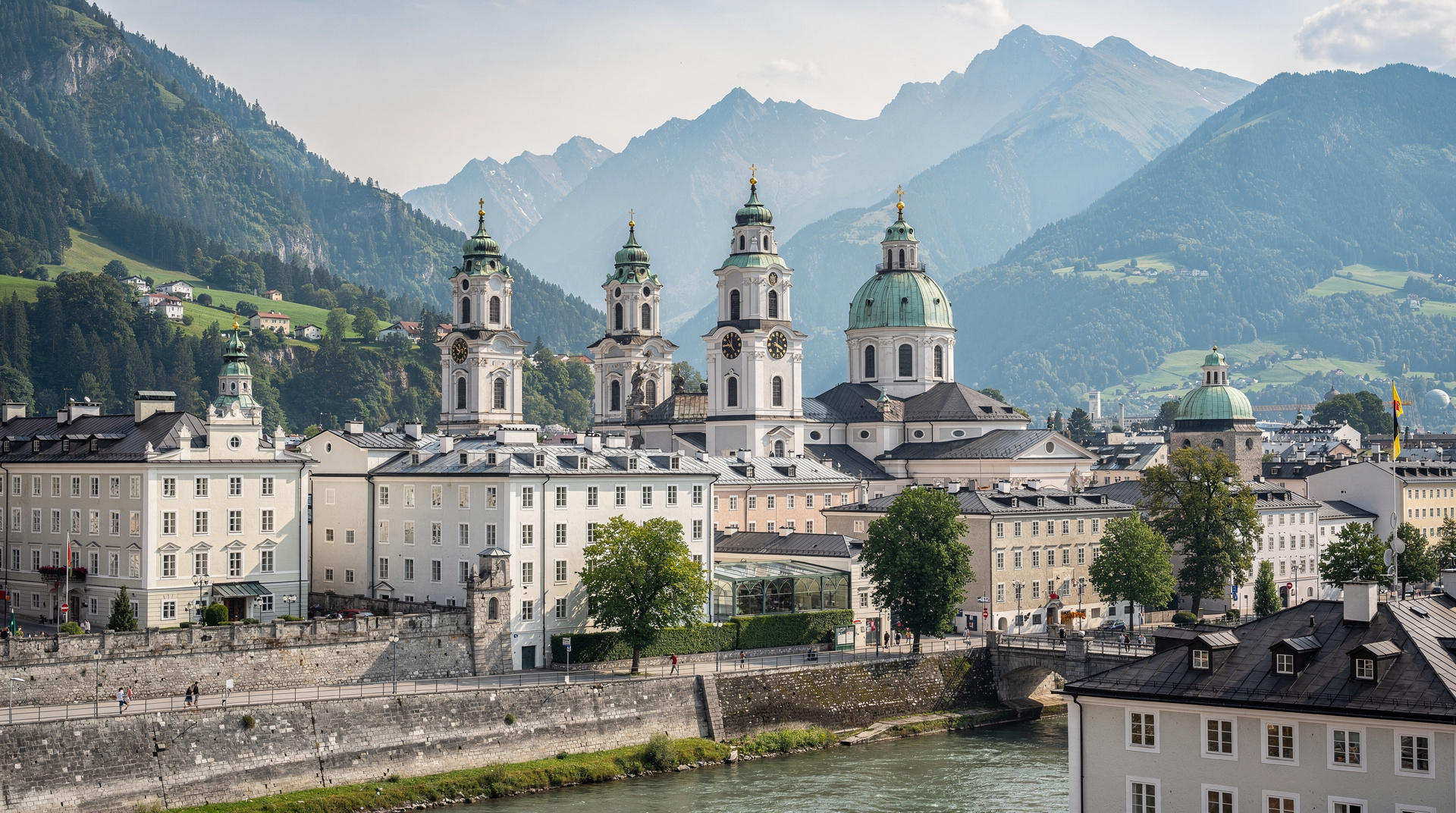
Salzburg is compact, architecturally extraordinary, and consistently misrepresented in generic travel content. The generic version says: Mozart, Sound of Music, fortress, Schnitzel. All true, but the framing misses why the city is genuinely worth the trip: it is one of the most intact baroque cities in Europe, it sits on two rivers with the Alps visible from the city centre, and it has a cultural density (festivals, concerts, museums, culinary heritage) that far exceeds its size.
Three days is the right amount of time for a first visit. See our how many days in Salzburg guide if you are debating. The short answer: two days is satisfying, three is the right amount, five is for people who want to see the surrounding region properly.
At a glance
| Structure | Day 1 city core, Day 2 history + right bank, Day 3 Hallstatt |
| Cost per person | approx. 254–274 € for 3 days excl. accommodation |
| Car | Not needed — guided tour or train covers Hallstatt |
| Best months | May, June, September, October |
| Book ahead | Fortress ticket + Hallstatt tour in July–August |
Before you arrive: what first-timers should know
The city is smaller than you expect
The entire UNESCO-listed Altstadt (historic core) is roughly 800 m from north to south and 400 m east-west. Hohensalzburg Fortress and Mirabell Gardens — the two most-visited points — are 15 minutes apart on foot. Most first-timers who worry about “getting around Salzburg” find the city so walkable that they barely use public transport.
Tourist traps to pre-empt
Two specific traps that trip up first-timers:
The Mozartkugel problem: The “original” Mozartkugel (a pistachio-marzipan-dark-chocolate ball in silver-and-blue wrapping) is made by Fürst confectionery, in business since 1890, sold only in their Salzburg shops. The ubiquitous red-wrapped Mirabell and Reber Mozartkugeln sold at every airport and supermarket are factory-made imitations. They are not bad chocolates, but they are not what the local sign says. Buy from Fürst (Alter Markt 13 and two other Salzburg locations) if you want the original. Read our real Mozartkugel guide.
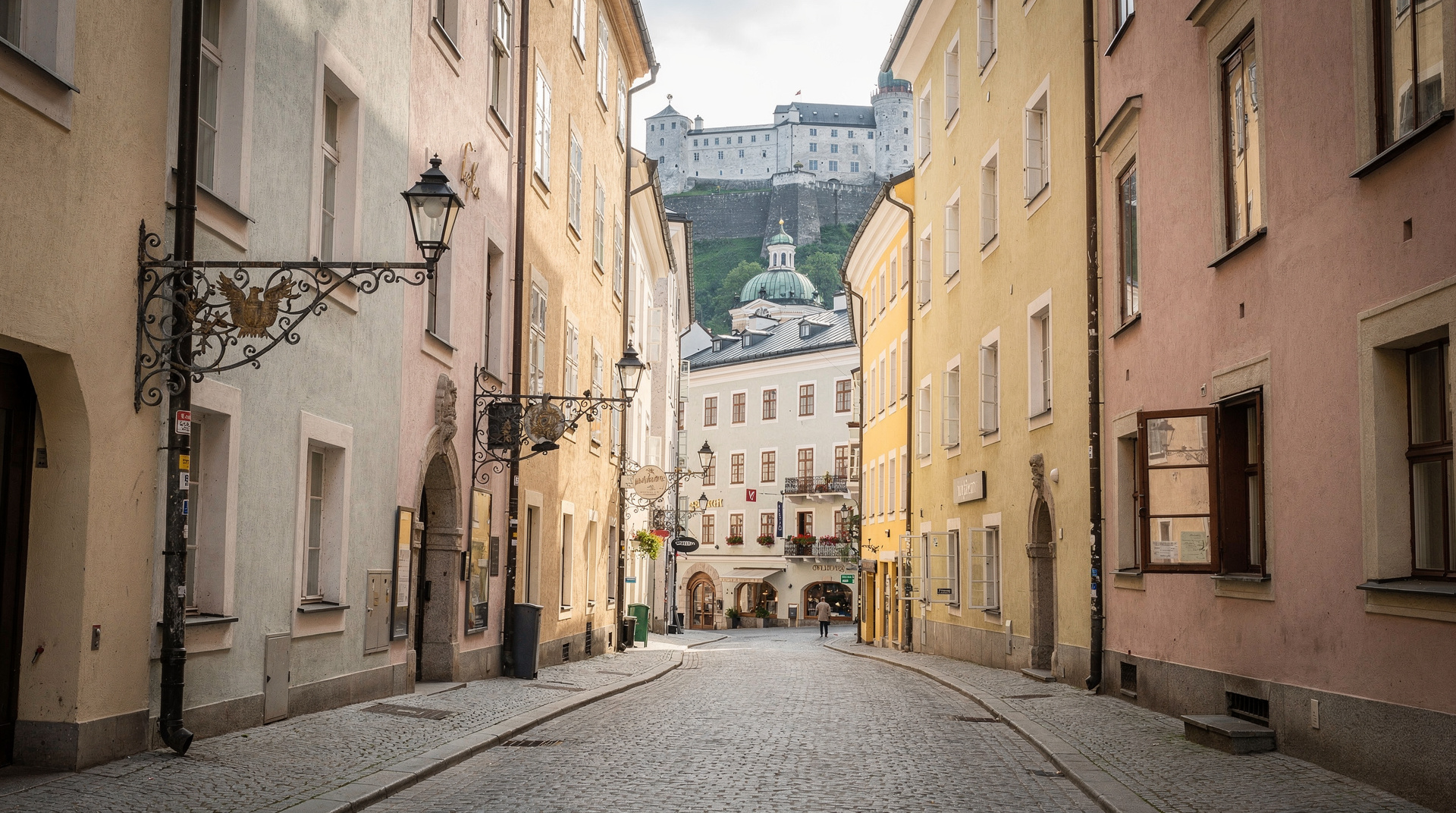
Getreidegasse restaurants: The most famous street in Salzburg is lined with restaurants. They are convenient, photogenic, and overpriced for the food quality delivered. This is a universal observation, not a single bad experience. Eat one street away (Judengasse, Chiemseegasse, Kaigasse) for substantially better value.
The Salzburg Card: run the numbers
The Salzburg Card (24-hour, 48-hour, or 72-hour) covers free admission to major attractions including the fortress, Hellbrunn, and most city museums, plus unlimited public transport. The 72-hour card is approximately 55 €.
For a 3-day first visit, it is worth it if you do fortress + DomQuartier + Hellbrunn + significant bus use. If you are only doing fortress and one other attraction, buy separately. Our Salzburg Card worth it guide has the break-even calculator.
Day 1: The city in its full context
Morning (08:30–12:30): Mirabell, Mozart, Getreidegasse
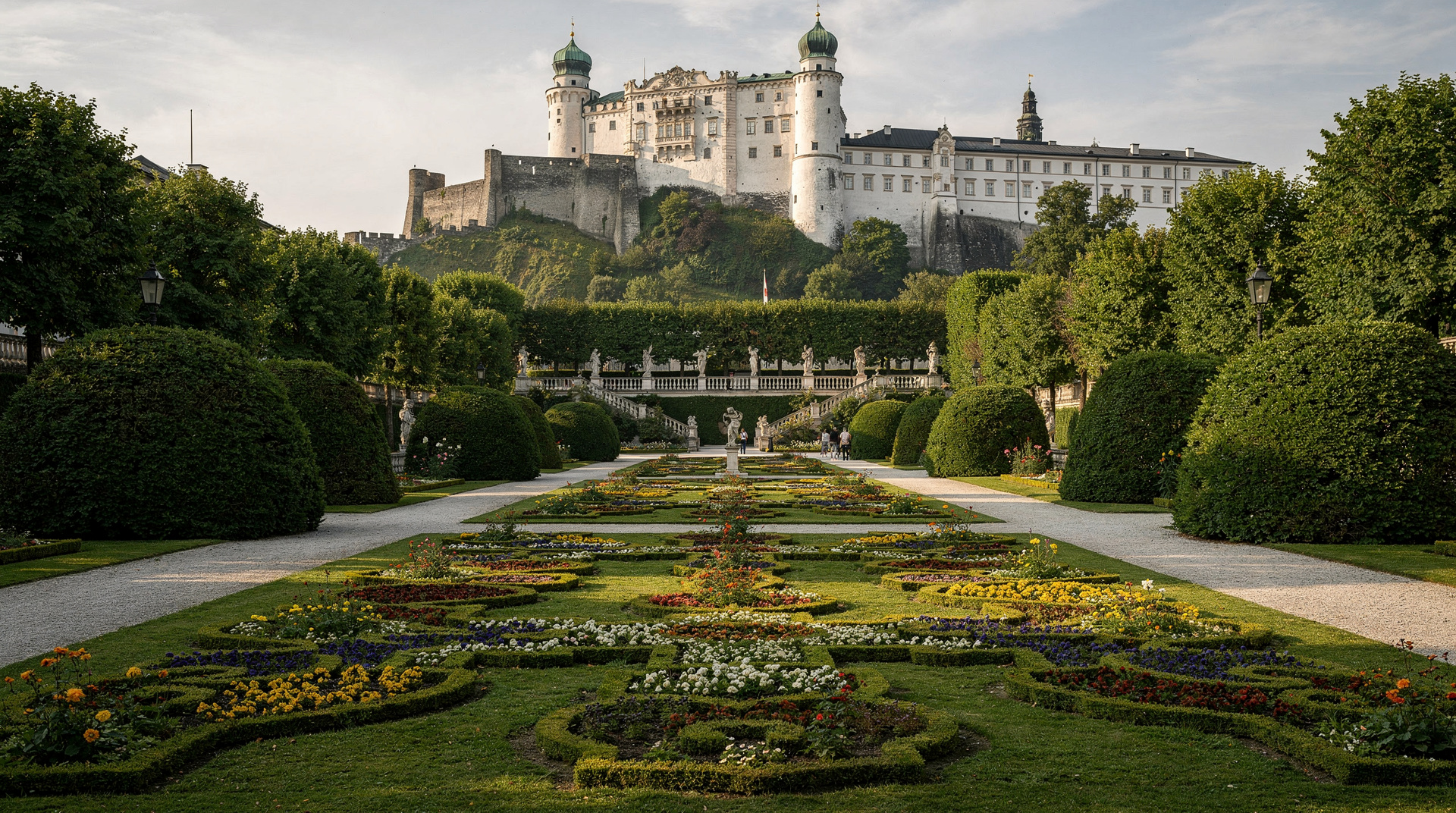
Start at Mirabell Palace and Gardens at 08:30 (free, open all day). The baroque fountain gardens are the best way to begin a Salzburg visit: free, uncrowded in early morning, and give you the first clear view of the fortress on the hill across the river — immediately telling you where the afternoon is going. 30–40 minutes here.
Walk south, cross Staatsbrücke bridge over the Salzach, and enter Salzburg Altstadt. Turn into Getreidegasse. The famous street with wrought-iron guild signs over every shopfront is genuinely photogenic; 20 minutes is enough. The McDonald’s at number 3 has one of the world’s most discreet fascias (forced to use the guild-sign format by historic preservation rules — it is a small Salzburg curiosity worth noticing).
At Getreidegasse 9, stop for Mozart’s Geburtshaus (birthplace, approx. 12 €). The apartment where Mozart was born in 1756 has his childhood violin, his first compositions in Leopold’s handwriting, and the physical context of a bourgeois Salzburg family home of the 18th century. Allow 45–60 minutes. See our Mozart birthplace vs. residence comparison for a brief guide to whether you should do both museums.
Honest Mozart note for first-timers: If music history is not your primary interest, the Geburtshaus can feel like a lot of explanation for a small collection. It is still worth doing once. If you are travelling with someone who is specifically not interested in Mozart, the Mirabell and fortress are the non-negotiable sights; the Geburtshaus is optional.
Walk the 2.5-hour Mozart and Old Town guided tour: the Salzburg 2.5-Hour Walking Tour covering Mozart, Old Town and more provides structured context for the city’s history, Mozart’s family story, and the Altstadt’s architectural logic. Good value for first-timers who want to understand what they are looking at.
Afternoon (12:30–17:30): Hohensalzburg Fortress
After lunch — eat at Triangel on Wiener-Philharmoniker-Gasse (reliable Austrian food, 5 min from the cathedral, 15–22 € per main) or Café Tomaselli (oldest café in Austria, Alter Markt, for coffee and pastry) — head to Hohensalzburg Fortress.
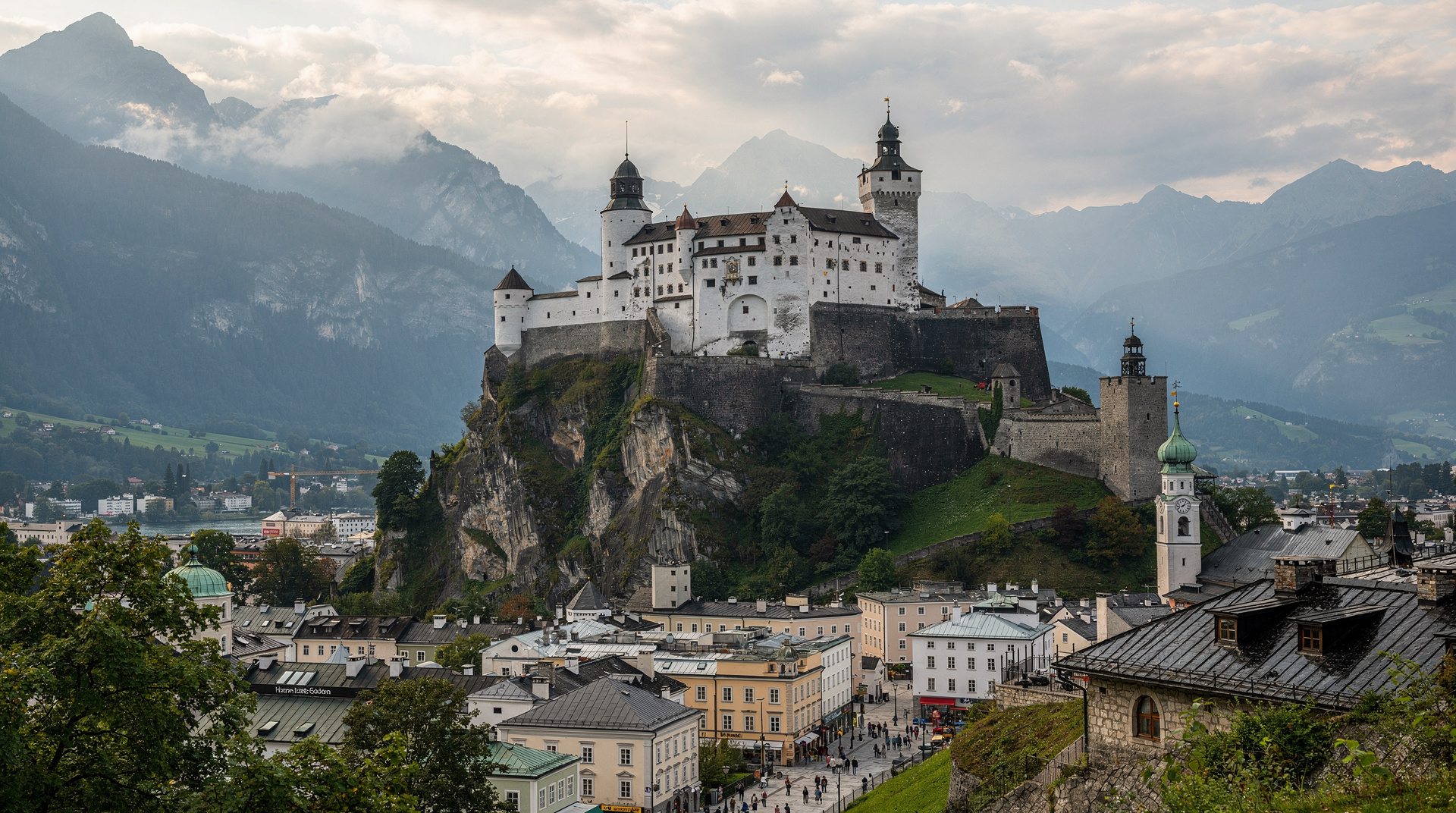
The fortress is the single most important thing to do in Salzburg. The view from the ramparts — across the Salzach, over the baroque domes and towers, toward the Untersberg and the Alps — tells you why this city exists where it does. The medieval interior (Gothic stove in the Princes’ Chamber, the marionette museum, the armour collection) provides three centuries of European political history in a single building.
The Hohensalzburg Fortress admission ticket includes the funicular (both ways), audio guide, and all interior sections. Approximately 16 €. Book ahead in July–August to avoid queuing at the funicular station. Allow 90 minutes minimum.
See our Hohensalzburg Fortress guide for what not to miss inside.
Evening (18:00–21:00)
For a first evening, choose between two genuinely different experiences:
Augustiner Bräustübl (15 minutes walk north from the Altstadt, via Mülln): the monastery beer hall that has been serving beer since 1621. Stone jugs of Augustiner draught, cold food from the stalls inside, hundreds of tables in vaulted halls and an outdoor garden. This is where the people of Salzburg drink. Expect 15–25 € per person. No booking needed; arrive early for the best garden tables.
Classical concert: The Mozart, Old Town and Mirabell Gardens Walking Tour ends near the concert venues. The Mirabell Palace concert (approx. 35–45 €) or the fortress concert (40–60 €) are both strong choices for a first evening in the city. See our best Mozart concerts in Salzburg guide for the honest comparison.
Day 2: History, art, and the right bank
Morning (09:00–12:30): DomQuartier and the Residenz
The DomQuartier (approx. 16 €) covers the Residenz palace state rooms, the walkway connecting the Residenz to the cathedral, and the Cathedral Museum. The Residenz was the seat of the Salzburg prince-archbishops — rulers who combined ecclesiastical and secular authority in a way that makes them fascinating figures in European history. The state rooms are frescoed with Baroque grandeur; the view from the walkway over Kapitelplatz is one of the city’s most memorable perspectives.
Allow 2 hours. See our Residenz and DomQuartier guide.
Salzburg Cathedral (free, adjacent, 20 minutes): the largest Gothic cathedral in the German-speaking world, rebuilt in baroque style in the 17th century. Mozart’s baptismal font is in the north transept. The frescoed vault and the organ case (one of the largest in Austria) are the architectural highlights.
Mozartplatz after the cathedral: the small square has a 19th-century Mozart statue (not contemporary with Mozart — he would have hated it, probably) and several pavement cafés. Fine for a coffee; bad for lunch prices.
Afternoon (13:00–17:30): the right bank and Kapuzinerberg
Cross the Salzach via Mozartsteg and walk the right bank. Steingasse is the narrow medieval street running parallel to the river — one of the least-touristed genuine old streets in Salzburg. At the far end, the Steingassturm (ancient city gate tower) is largely intact.
Walk up the Kapuzinerberg from Steingasse — 45 minutes to the summit along a well-marked path through forest. The monastery at the top is active (Capuchin monks) and the view from the summit wall over the Altstadt is the best from any free, accessible high point in Salzburg. See our Kapuzinerberg walk guide.
Descend via the other path and cross back to the Altstadt via Staatsbrücke. Afternoon coffee at Café Tomaselli (if you didn’t stop yesterday) or Café Sacher Salzburg (the extension of the Vienna Sacher, serving the famous Sachertorte — excellent if you want it, tourist-priced at 8 € per slice).
Evening
Hellbrunn option: If you want to add Hellbrunn to day 2 rather than day 3, take bus 25 (15 min) after Kapuzinerberg for the trick fountains and palace grounds. Our Hellbrunn worth it guide makes the case: yes, it is worth it on a 3-day visit.
Otherwise: dinner in the Altstadt. Bärenwirt on the right bank (Müllner Hauptstrasse) is the best traditional Austrian restaurant near the city centre — Salzburger Nockerl, Tafelspitz, good wine list. Reserve ahead.
Day 3: Hallstatt — the definitive first-timer add-on
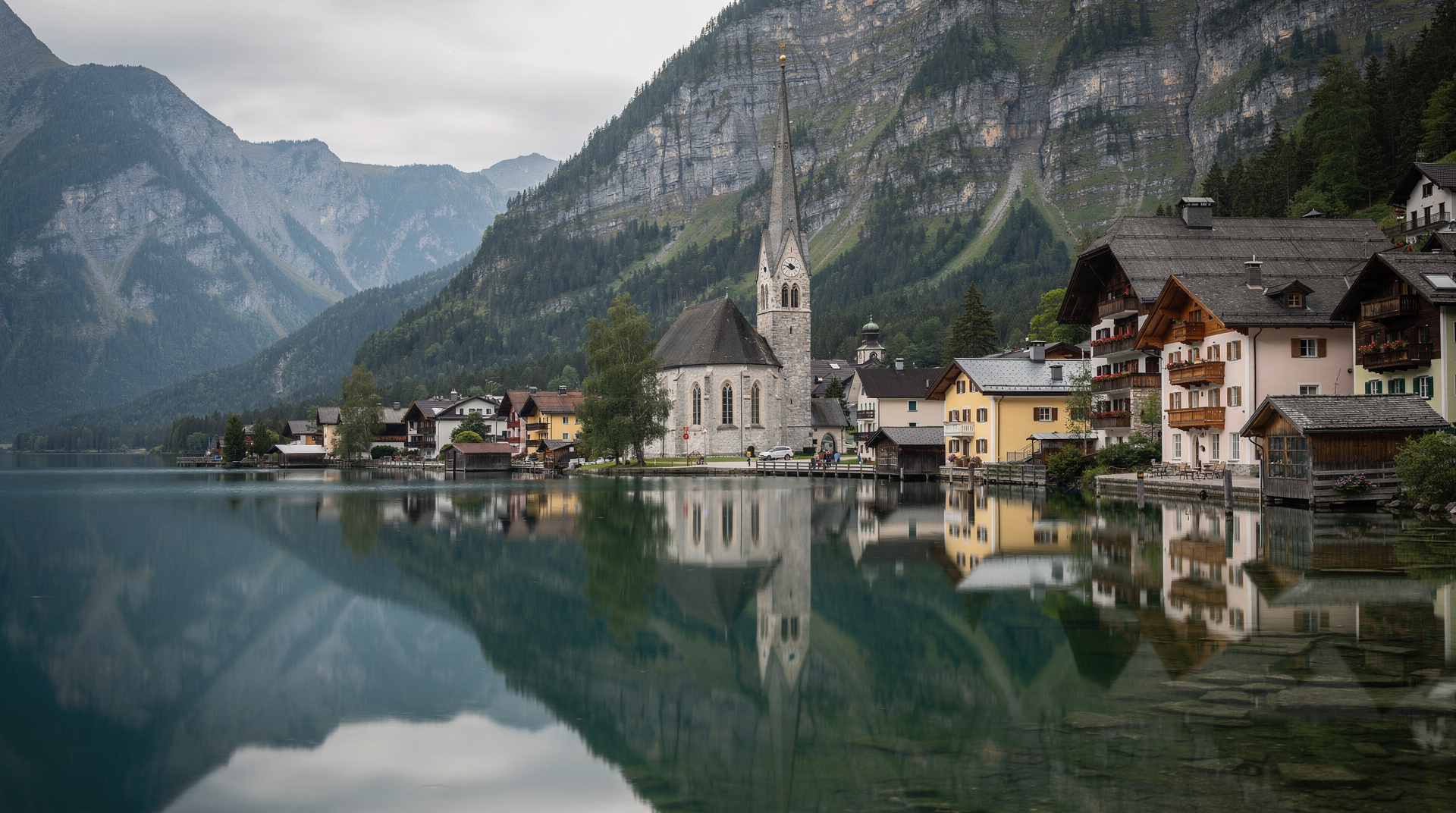
Hallstatt is the single most compelling day trip from Salzburg for a first-time visitor. It is the most photographed village in Austria, it sits in the most dramatic alpine lake setting in the country, and it is exactly as beautiful as the photographs suggest — with the important caveat that it is also genuinely overcrowded in summer between 11:00 and 16:00.
The critical timing
Leave Salzburg by 08:00 in summer. In May, June, September, and October, 08:30 is fine. If you arrive in Hallstatt by 09:00, you will see the village in near-solitude with morning mist still on the lake. If you arrive at 10:30, you will be navigating other tourists. The 90-minute time difference is that consequential. See our Hallstatt overcrowding guide.
Getting there
By guided tour: The half-day Hallstatt tour from Salzburg departs early, handles all logistics (transport, parking, guide), and gives 3–4 hours in the village. This is the easiest option for first-timers who don’t want to deal with Austrian train connections.
By public transport (independent): ÖBB train from Salzburg Hauptbahnhof to Attnang-Puchheim (40 minutes), change for Hallstatt station (60 minutes), then the ferry across the lake to the village (10 minutes). Total: 2h15. Return ticket approx. 28–32 €. The ferry runs every 30 minutes when trains arrive. Our Hallstatt train guide has the exact connections.
By car: 1 hour via A10 motorway and B145. Satellite car parks fill before 09:00 in July–August; arrive early. The village itself has almost no parking.
What to see in Hallstatt
4–5 hours covers everything:
The village walk (45 minutes): the market square, the lakeside promenade, the medieval houses built up the cliff face. Walk to the northern end of the village where the houses stop and the cliff descends directly to the lake.
Bone Chapel (Beinhaus, 3 €): behind the Catholic church, 1200 decorated skulls — the result of centuries of limited cemetery space. Unusual, memorable, genuinely historically significant.
Hallstatt Skywalk (approx. 16 € funicular return): the cable car up to a viewpoint above the village, with a glass platform extending over the cliff edge. Best views over the lake and village. Worth it on a clear morning.
Salt Mine (38 € with funicular): the oldest salt mine in the world, with evidence of Celtic miners from 7000 BCE. The underground tour includes metal slides and a boat ride on an underground lake. Optional but genuinely interesting — add 1.5 hours if you want it. See our Hallstatt salt mine and skywalk guide.
Lunch in Hallstatt: tourist-priced but the lakeside setting earns it once. Bräugasthof am Hallstättersee is the most reliable option. Leave by 14:00 before the afternoon traffic peak.
Return and final evening
Return to Salzburg by 16:30. Final evening at Augustiner Bräustübl (if you missed it on day 1) or a farewell dinner at one of the Altstadt restaurants. Buy Fürst Mozartkugeln on Alter Markt.
What to skip on a first visit
With three days, some things simply don’t make the cut:
Mozart Wohnhaus (Residence): Worth doing if you are a Mozart devotee or have extra time. For a typical first visit where you’ve done the Geburtshaus, this is the item most likely to be cut without loss.
Untersberg cable car in poor weather: The mountain views are the point. If visibility is under 2 km, the cable car costs the same and shows you a cloud.
Hellbrunn: Borderline — it is excellent but requires half an afternoon. On a tight 3-day first visit, it can reasonably be deferred to a second trip. If you have a Day 2 afternoon free, add it.
Gaisberg drive: A good panoramic drive above the city but adds 1.5 hours without any major single attraction. For second-timers.
Salzburg Card: is it worth it for 3 days?
Run the numbers for your specific programme:
| Attraction | Standard price | Covered by 72h Card |
|---|---|---|
| Hohensalzburg Fortress | 16 € | Yes |
| DomQuartier | 16 € | Yes |
| Hellbrunn Palace | 14 € | Yes |
| Mozart Geburtshaus | 12 € | Yes |
| Mirabell Palace tour | 13 € | Yes |
| City bus (3 days) | ~15 € | Yes |
| 72h Card price | ~55 € | — |
If you are doing fortress + DomQuartier + Hellbrunn + bus use, the card pays for itself. If you are only doing fortress and Mozart, buy tickets individually. Our Salzburg Card guide has the full breakdown.
Costs and logistics
Transport within Salzburg: A single bus ticket is approximately 2.10 €; a day pass is 5.70 €; the 72-hour card (covered by Salzburg Card) or the Klimaticket (annual) apply for longer stays. For most sights on this itinerary, walking is faster.
Getting from the airport: Bus lines 2 and 10 run direct from Salzburg Airport to the Altstadt in 20 minutes for approximately 2–3 €. Taxi costs about 15 €. The airport is 4 km from the city centre — one of the closest major-city airport-centre relationships in Europe. See our Salzburg airport to city guide.
Total cost per person for 3 days (no concert, no Hallstatt salt mine):
- Fortress: 16 €
- Mozart Geburtshaus: 12 €
- DomQuartier: 16 €
- Hallstatt tour: 45–65 €
- Meals (3 × 50 €): 150 €
- Transport (3 days): 15 €
- Total: approx. 254–274 €
Plus accommodation (3 nights × 80–180 € = 240–540 €).
For the full breakdown with budget, mid-range, and splurge scenarios, see our Salzburg trip cost guide.
First-timer questions that generic guides skip
A few practical points that don’t fit neatly into the day-by-day structure but matter for a genuinely first Salzburg visit:
Cash vs. card: Austria is more card-friendly than it was a decade ago, but small vendors — market stalls at Universitätsplatz, some Getreidegasse guild-sign photo spots with a tip jar, the Bone Chapel donation box in Hallstatt — still expect cash. Carry 20–30 € in small notes and coins for the trip.
Tipping: Round up or add 5–10% at restaurants; it is not automatically included and not as expected as in the US, but a small tip for good service is normal and appreciated. Leave it in cash directly with the server rather than adding it to a card payment where possible.
Language: German is the local language, but English is near-universal in the tourism sector — hotels, restaurants, ticket offices, and tour guides. Learning “Grüß Gott” (the regional greeting) and “Danke” goes further than expected for first impressions, but it is not necessary for basic logistics.
Sunday closures: Most shops (not restaurants or tourist attractions) close on Sundays. If day 2 or 3 of your visit falls on a Sunday and you wanted to buy Fürst Mozartkugeln or other souvenirs, check opening hours or shift the shopping to a weekday.
Water and public toilets: Salzburg tap water is safe to drink and genuinely good — refilling a bottle at any café or public fountain is normal and expected, and there’s no need to buy bottled water throughout the trip. Public toilets are less frequent than in some cities; the fortress, DomQuartier, and any café you’re a customer at are the reliable options, and it’s worth using facilities before setting off on the Kapuzinerberg walk or the Hallstatt day, since the intervening stretches have few options.
What first-timers consistently get wrong about pacing: The single most common mistake among visitors doing this exact itinerary is treating day 1 as a “sightseeing marathon” because it’s the first day and energy is high. The fortress alone deserves 90 unhurried minutes, not a rushed 45; rushing it to fit in extra stops is the single most regretted decision reported by first-time visitors reviewing their own trips afterward.
Comparing this itinerary to other first-timer options
This guide assumes a no-car, guided-tour-friendly first visit. If your first visit has a car and you’re deciding between structures, our 3-day itinerary covers similar ground but adds Eagle’s Nest instead of stopping at Hallstatt alone — a reasonable upgrade if World War II history interests you as much as lake scenery.
For a shorter first taste, the 2-day itinerary compresses this exact structure by cutting one city day; for more depth, 5 days adds the Bavarian Alps and a second lake-district day. This 3-day, no-car, Hallstatt-focused version remains the single most commonly recommended structure for genuine first-time visitors, and the reasoning above explains why.
Frequently asked questions for first-timers
What is the single most important thing to do in Salzburg?
Hohensalzburg Fortress. The view from the ramparts — over the Altstadt, the Salzach, and the Alps — gives you the spatial understanding of the city that everything else builds on. Do this first.
Is the Altstadt hard to navigate?
No. The Altstadt is a 15-minute walk end-to-end. The main street (Getreidegasse) runs east-west; the fortress is due south; Mirabell is across the river. After 30 minutes of walking you will have the layout instinctively.
Should I book anything in advance?
In July–August: book the fortress ticket ahead (online, avoid the queue), book any evening concert at least a week ahead, and book the Hallstatt tour 24–48 hours ahead. In shoulder season (May–June, September–October): usually fine 1–2 days ahead. See our Salzburg first time guide for the full advance booking checklist.
Is Salzburg expensive?
Mid-range — comparable to Vienna and Munich. Budget: 60–90 € per person per day (hostel, cheap eats, free/cheap sights). Mid-range: 120–180 € per person per day (hotel, restaurant lunches and dinners, standard paid attractions). Luxury: 300 €+ per person per day (boutique hotels, Festival tickets, tasting menus).
What are the best free things to do in Salzburg?
Mirabell Gardens, the Altstadt walk, the Kapuzinerberg hill path, the Salzach riverside, and all exterior views of the cathedral, Residenz, and fortress. The fortress, DomQuartier, and Mozart museums are the main paid attractions. Salzburg Cathedral interior is free.
How do I avoid the worst tourist traps?
Three rules: don’t eat on Getreidegasse (eat one block away), don’t buy the red-wrapped Mozartkugeln (buy from Fürst on Alter Markt), and don’t take a concert from a costumed tout outside the Staatsoper or Albertinaplatz (they sell seats to overpriced mediocre concerts). Read our Salzburg tourist traps guide for the full list.
Top experiences
Bookable activities with verified prices and instant confirmation on GetYourGuide.